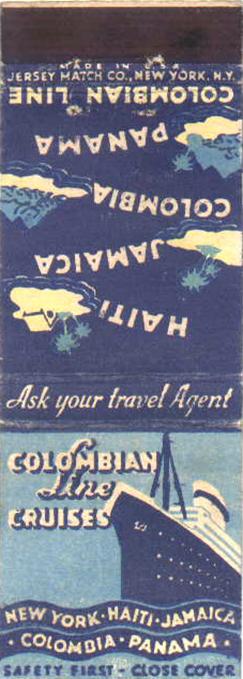
- A "manumark"
("mm") is the line or lines of text immediately below
the striker on front-striker covers (pre-1979), such as the one
pictured above left. On reverse-striker covers, which were mandated
in 1973 and became universal by the end of 1978, the mm would
be above the striker. In some cases, the mm will be found on
the inside of the cover, and in a few instances there may be
no mm shown at all. The mm can be 1-3 lines, right-side up or
upside down.
-
- Manumarks are very important
little fellows. They can tell who the manufacturer was, where
the matchbook was produced (or at least the point of distribution),
and how old the matchbook is.....but not always, and not necessarily
all three items together. So, let's take a look at the information
a manumark can give the collector and under what circumstances.
Here's an example.
-
-
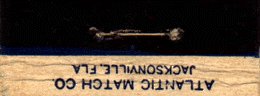
- This mm tells us that
this cover was produced by the Atlantic Match. Co. We'll discuss
below those instances where you can't trust what the mm says,
but this one's OK. Atlantic Match Co. was a match manufacturer.
It also says "JACKSONVILLE, FLA." That's where Atlantic
and its plant were located, so that's where the matchbook was
produced. The manumark gives no date of origin, but if you do
your research (see "The
American Match Industry: A Biograph") you can find in which years Atlantic was in production,
and, in many cases, if you have the right reference tool, you
can actually narrow it down even further and find out in which
years that specific mm was in use (see "MM Dating Guide" ).
-
- Simple, yes? (you know
there's a catch coming, right?) Well, it's a t-i-n-y bit
more complicated than that because, truth-be-told, as far as
manufacturer and location are concerned, you can't always rely
on what the mm says! It turns out that, in many cases, the manumark
doesn't refer to the manufacturer at all. Look at this example:
-
-
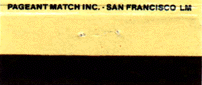
- If you didn't know better,
you'd simply assume that the manufacturer here was Pageant Match
and that the matchbook was produced in San Francisco....not so!
Pageant Match was not a manufacturer at all. It was a sales and
distribution company, taking orders and passing them on to mainly
Japanese manufacturers...and making sure that its own name appears
in the mm. By the same token, there was no production plant in
San Francisco; that's simply where the Pageant office was that
was responsible for the order.
-
- As it turns out, any Tom,
Dick, or Harry can get his name in the mm. If Bob's Novelty Co.
is the one handing the order and sending it into the manufacturer,
then the mm on those covers will more than likely read "Bob's
Novelty Co." The knowledgeable collector knows who is an
actual manufacturer and who isn't, even though many of these
non-manufacturing middle men actually call themselves "match
companies" (i.e., "Arthurian Match Co., Camelot, England").
-
- Complicated now?....Well,
it's even more complicated than that...because even if the mm
does contain the actual manufacturer's name, the location
shown, especially for the larger manufacturers, may not be the
production location. Look at the following example:
-

-
- Atlas was, indeed, a manufacturer,
but it had no production plant in Houston. That's simply the
branch office that handled the particular order. The more experienced
you become, the easier you'll find it to decode the manumarks
you come across.
-
- Aside from the decoding,
manumarks are of prime interest to collectors who focus on old
covers. These collectors are looking for covers from old, defunct
match manufacturers. So, they look for those companies' manumarks.
Crown, King Midas, Star, Jersey, Manhattan, Union, Gem, General,
and others are manumark names that are sure to spark a collector's
interest!
-
-
- "Footers" technically
include any manufacturer's (as opposed to advertising) text located
at the foot of the matchcover....that's normally where the "close
cover before striking" is to be found. Thus, the "close
cover before striking" is a footer. But, that's not the
type of footer that is of interest to most collectors. There
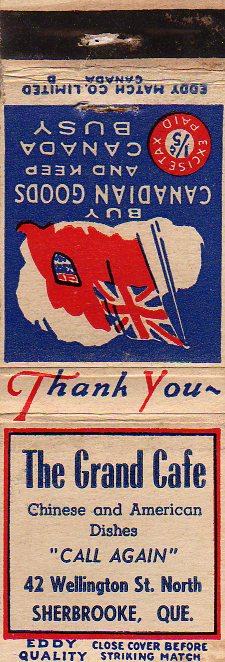
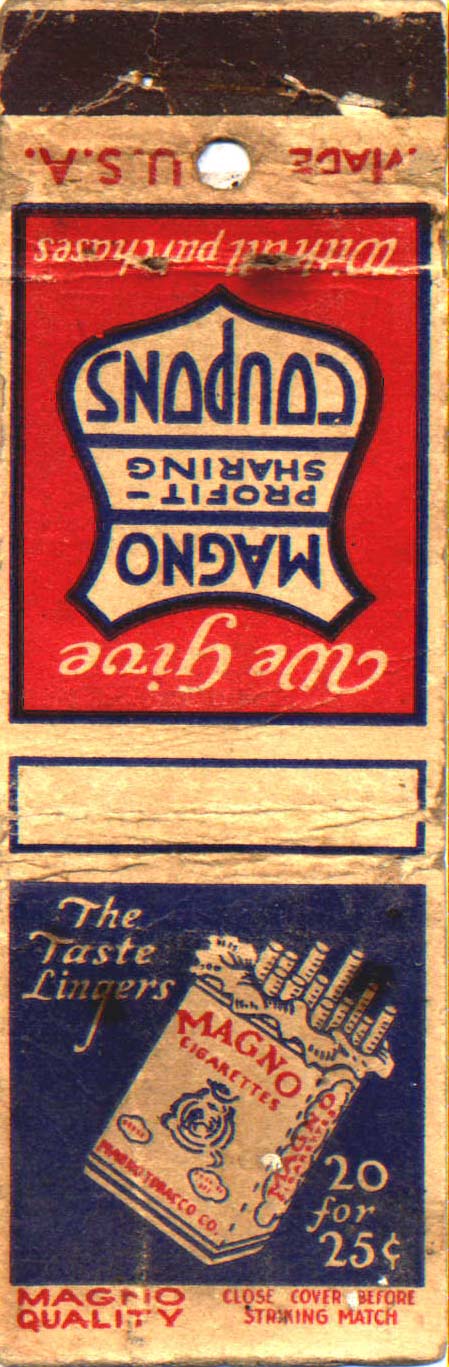
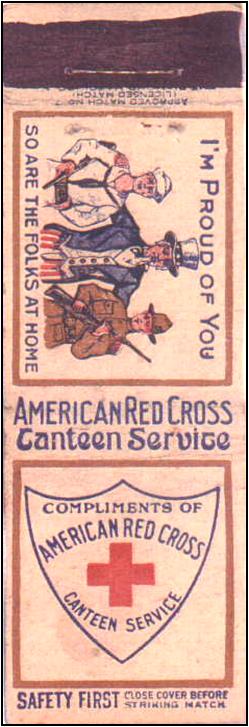
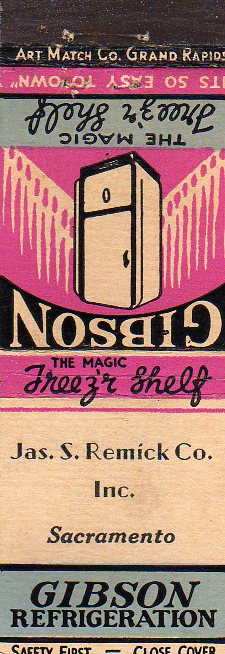
are special, highly sought-after footers. Observe...
-

 

-
- These are four of the
more famous footers. They were used, in most cases, by the respective
manufacturers as trademarks for certain covers. Special footers
such as these basically disappeared by World War II. Hence, when
a collector happens upon one, he knows he's looking at an o-l-d
cover. When you're looking for this type of footer, any that
have "Quality" are good (various manufacturers put
out various Qualities...i.e., "Eddy Quality," "Magno Quality," "Union
Quality," etc.);
any that have "Safety First" are good (i.e., Diamond, Art, Jersey, Lion, Hercules, and other companies
all put out Safety Firsts). Plus, there are other types, two
of which are pictured above.
-
- Additionally, as with
manumarks, these footers can also be dated to the specific range
of years when they were actually used by their respective manufacturers.
|